Unlike traditional humanities programs which focus on developing specific expertises, we encourage students to explore a wide range of subjects and learn across different disciplines.
In a world where complex challenges rarely have simple answers, we believe that students need more than knowledge from one field. They need the ability to connect ideas, understand different perspectives, think critically, and develop their own solutions.
At BAHS, learning is not only about gaining knowledge. It is about developing the ability to understand people, navigate cultural complexity, work across languages and technologies, and respond creatively to the rapidly changing challenges of the contemporary world. Our Program Learning Outcomes are designed to prepare graduates who can think critically, communicate meaningfully, and contribute responsibly to society in both local and global contexts.
PLO 1: Graduates can apply humanistic, cultural, and social science concepts to understand contemporary global challenges and provide guidance for the public to lead sustainable lives and societies.
PLO 2: Graduates can leverage media, applications, and digital technologies to advance human values in an era of artificial intelligence transformation and disruption.
PLO 3: Graduates can communicate in multiple languages and apply cross cultural knowledge and emotional intelligence to build meaningful connections, enhance social interactions and teamwork, and promote understanding among people from diverse countries and cultures.
PLO 4: (For students in the Cooperative Education Track): Graduates can apply academic knowledge and skills in professional workplaces to support organisations in achieving their tasks and goals.
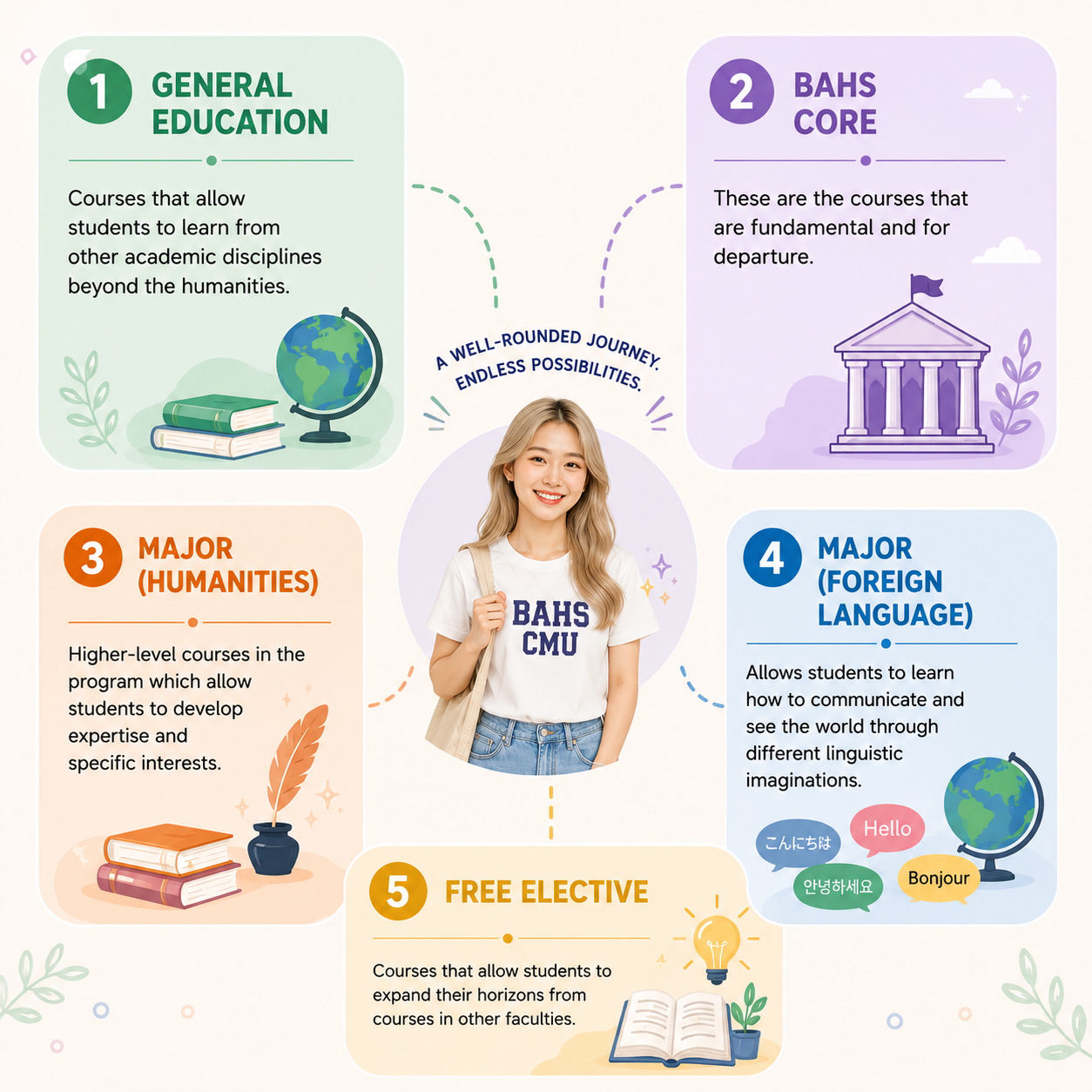
In our program, students have a wide range of courses to choose from. These courses are structured into five groups, and students are required to complete the minimum requirements for each group: 1) General Education (GE), 2) BAHS Core Courses, 3) Major Humanities Courses, 4) Major Foreign Language Courses, and 5) Free Electives.
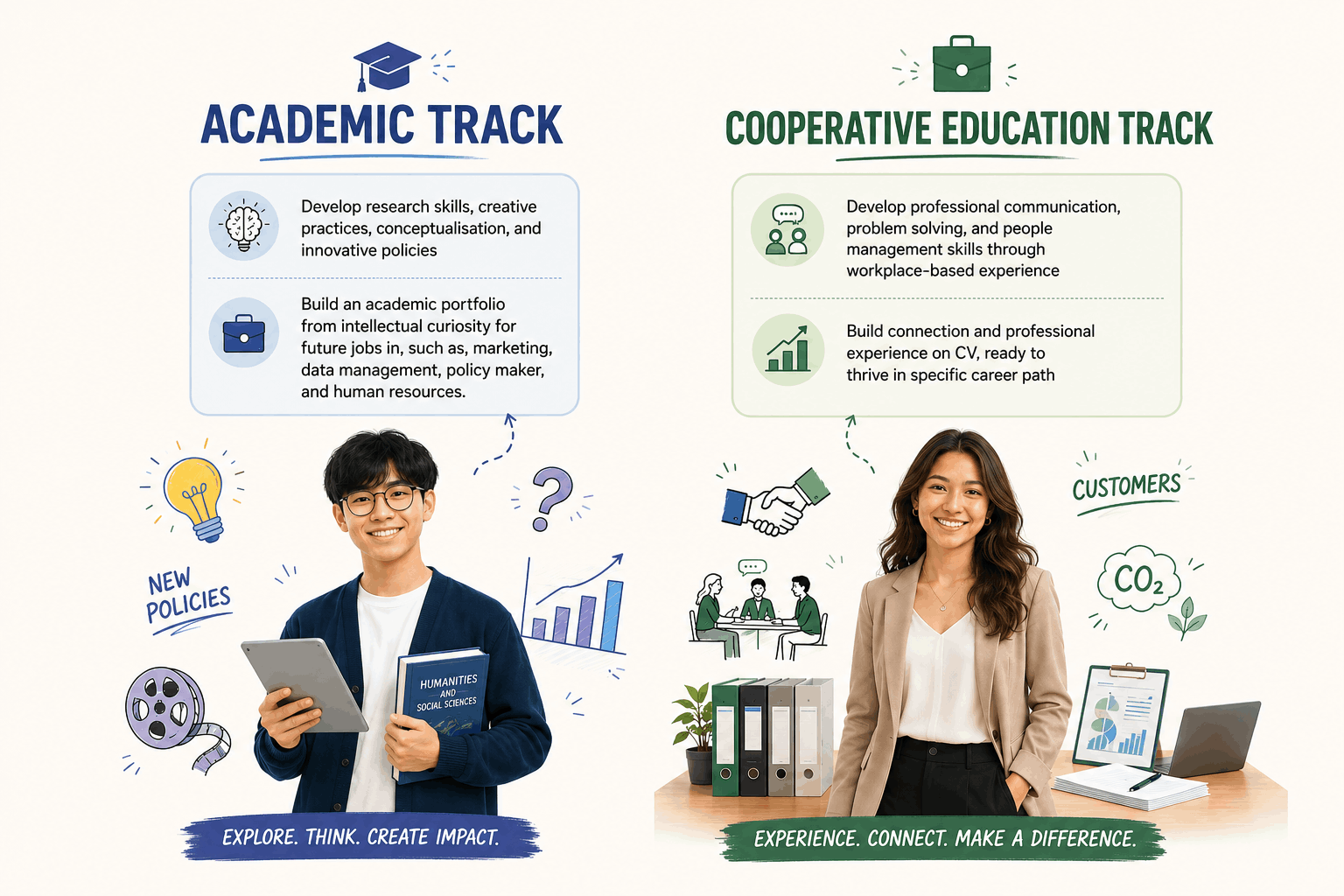
Students in the program have the opportunity to develop their distinctive strengths through two study pathways: the Academic Track and the Cooperative Education Track. While both tracks are designed to cultivate critical thinking, research skills, adaptability, and lifelong learning, each offers a different learning experience and professional focus.
Sustainability is increasingly important across professional organisations. Our graduates can apply their humanistic and cultural knowledge and skills to help organisations work with people, communicate sustainability values, and create positive change. Career opportunities may include roles such as Sustainability Officer, CSR Coordinator, Community Engagement Officer, Sustainability Communications Specialist, ESG Coordinator, and Social Impact Officer.
With strong human and cultural literacy, our graduates are equipped to understand and work effectively with people from diverse backgrounds. They can bring these skills into organisations to support talent development, employee engagement, workplace culture, and organisational development. Possible roles include HR Officer, Learning and Development Specialist, Talent Development Coordinator, Employee Engagement Officer, and People & Culture Officer.
Our program develops human and cultural literacy, enabling graduates to understand diverse people, perspectives, values, and cultural contexts. Combined with strong communication skills, this prepares them to build meaningful relationships with audiences, customers, and communities. Roles may include Communications Officer, Public Relations Officer, Customer Relations Officer, Client Relations Specialist, Content Coordinator, and Community Engagement Officer.
Graduates can apply their knowledge of people, cultures, histories, identities, and societies to work across borders and engage with diverse international communities. Their humanistic perspective enables them to explore the cultural and human dimensions of international relationships, communication, cooperation, and global affairs. Career paths can be, for example, International Relations Officer, International Program Coordinator, Foreign Affairs Officer, International Development Officer, and Cultural Exchange Coordinator.
Human and cultural literacy provides a strong foundation for working with people in educational and developmental settings. Graduates can apply their knowledge and communication skills to teaching, training, mentoring, and personal development. Career opportunities may include Educator, Learning Facilitator, Training Coordinator, Academic Advisor, Education Program Officer, and Life or Career Coach.
Humanistic knowledge provides valuable perspectives for understanding communities, social issues, cultural differences, and people’s lived experiences. Graduates can apply these perspectives to community-based work, social development, public services, advocacy, and support programmes. Professional roles as Community Development Officer, Social Development Officer, Public Service Officer, NGO Program Officer, Community Outreach Officer, and Social Work Assistant, are highly relevant.
Graduates can apply knowledge in the program to develop, manage, and communicate cultural and creative projects and events. Career opportunities may include Arts & Culture Coordinator, Cultural Events Officer, Festival Coordinator, Museum or Gallery Officer, Creative Project Coordinator, and Cultural Programme Officer.
Humanities graduates bring human and cultural literacy to the management, interpretation, and preservation of information. Combined with data and digital technology skills, they can work across archives, libraries, museums, research institutions, and organisations managing large collections of information. Career opportunities include Archivist, Digital Archivist, Records Manager, Data Coordinator, and Information Management Officer.
HTML Website Builder